

RFI in Manufacturing: Definition, Purpose, and Typical Use Cases
In manufacturing, a weak supplier search can lead to expensive delays, poor fit, and avoidable quality risk. An RFI helps teams gather facts before they ask for quotes, negotiate terms, or commit to a production path. Used well, it saves time, sharpens requirements, and reduces bad purchasing decisions.
What RFI Means in a Manufacturing Context
View this post on Instagram
RFI stands for Request for Information. In plain terms, it is a structured way to ask suppliers, manufacturers, service providers, or partners for information before a buyer moves into a more formal sourcing or procurement stage.
A federal acquisition definition captures the core idea well: an RFI is used when the buyer does not yet intend to award a contract and wants information such as capabilities, delivery, pricing direction, or market input for planning. Responses are treated as information, not binding offers.
In manufacturing, that general idea shows up in several practical ways:
- A sourcing team may send an RFI to identify which contract manufacturers can handle a new product line.
- A procurement manager may use one to compare supplier capabilities before issuing an RFQ.
- A quality or compliance team may use an RFI to collect declarations, certifications, or material data from suppliers.
- An engineering team may use an RFI to clarify process, tooling, or specification questions early in a project.
Oracle’s manufacturing and sourcing documentation reflects both sides of that reality. In sourcing, RFIs are used to gather general information about suppliers, products, services, or market capability before a quoting stage.
In manufacturing compliance, an RFI can also serve as a formal request for supplier compliance data tied to parts and specifications.
Why Manufacturers Use RFIs
Manufacturing companies rarely buy on price alone. Supplier choice affects lead time, tooling readiness, quality systems, regulatory exposure, inventory strategy, and production stability.
An RFI helps a company answer early-stage questions such as:
- Can a supplier actually produce what the drawings require?
- Does the supplier hold the certifications a regulated customer needs?
- Can the supplier support forecast swings or seasonal demand?
- Does the supplier have a domestic plant, offshore plant, or both?
- How mature is the supplier’s quality system?
- Can the supplier support pilot runs, low-volume builds, or fast changeovers?
- What materials, finishes, or testing methods can the supplier handle?
Without that fact-finding step, buyers often move too fast into a quote request and end up comparing numbers from vendors who are not truly comparable.
SAP’s sourcing guidance describes the RFI as a non-competitive event used to collect information, gather feedback, and qualify participants before later bidding stages.
Oracle’s sourcing documentation says much the same, noting that RFIs are for general supplier and market information, while later events handle pricing and supply attributes.
RFI vs. RFQ vs. RFP
Confusion around RFIs usually starts here. Many teams use the terms loosely, especially in small and mid-sized firms. In practice, each serves a different purpose.
| Document | Main Goal | Typical Timing | What Buyer Wants |
| RFI | Gather information | Early stage | Capabilities, capacity, certifications, process fit, general market input |
| RFQ | Get pricing | After requirements are clearer | Unit cost, tooling cost, lead times, MOQs, freight terms |
| RFP | Get a fuller proposal | When solution design matters | Technical approach, implementation plan, service model, commercial terms |
An RFI comes first when the buyer still needs to narrow the field or refine requirements. A quote request works better when part specs, volumes, and commercial assumptions are already clear.
An RFP fits cases where the supplier must propose a broader solution, such as automation integration, plant equipment, or outsourced production services.
What an RFI Usually Includes
A solid manufacturing RFI is focused enough to produce usable answers, but broad enough to reveal differences between suppliers. Most include a mix of company, technical, operational, and compliance questions.
Supplier Background
Buyers often ask for:
- company size and ownership structure
- plant locations
- major customer industries
- years in operation
- production footprint
- key equipment or core processes
That basic profile helps a buyer separate true manufacturers from brokers, very small shops from scaled operators, and local players from global networks.
Technical Capability
For direct materials or precision manufacturing work, an RFI may ask about:
- machining, molding, stamping, fabrication, or assembly capability
- tolerances the supplier can routinely hold
- supported materials and grades
- finishing and surface treatment options
- tooling design support
- prototyping and pilot-run capability
- inspection and metrology resources
At that point, the buyer is looking for fit, not a final promise.
Quality and Compliance

In regulated or quality-sensitive sectors, RFIs often move far beyond a simple questionnaire.
Oracle’s manufacturing compliance guidance describes RFIs as a way for manufacturers to seek compliance data from suppliers, including confirmation that supplied parts meet relevant specifications.
In food and pharmaceutical manufacturing, supplier approval and verification can be central to regulatory compliance, with FDA guidance and CGMP materials emphasizing supplier controls, facilities, methods, and process capability.
Questions here may cover:
- ISO 9001, IATF 16949, AS9100, ISO 13485, or similar certifications
- material traceability
- PPAP support
- certificates of analysis
- audit history
- corrective action process
- change notification process
- environmental or chemical compliance declarations
Capacity and Delivery
A supplier may look strong on paper but still be a bad fit if capacity is tight or changeover times are poor.
Manufacturing RFIs often ask about:
- monthly and quarterly capacity
- shift structure
- surge capacity
- average lead times
- production planning system
- inventory strategy
- warehouse footprint
- domestic versus overseas shipping options
That information matters because a low quote from an overloaded supplier can end up costing more in missed schedules, expedited freight, or premium rework.
Typical Use Cases for RFIs in Manufacturing

RFI use varies by company size, industry, and supply chain risk. A few patterns show up again and again.
New Product Introduction
When a company is preparing to launch a new product, the team may not yet know which suppliers can support the design, tooling approach, target volumes, or quality requirements.
An RFI helps identify:
- which suppliers can build prototypes
- which ones can scale into serial production
- whether alternate materials are available
- whether secondary operations must be outsourced
- what lead-time risks may appear before launch
Oracle notes that sourcing events can be triggered by new product introduction, among other business needs. In practice, that makes the RFI an early filter before heavier quote work begins.
Supplier Qualification and Reduction of the Supply Base
Many manufacturers start with too many potential vendors, especially after years of ad hoc buying. An RFI helps narrow the field.
SAP’s guidance says RFIs are commonly used to consolidate or narrow the supply base, learn supplier capabilities, and qualify suppliers before later bidding.
A mid-sized manufacturer might send an RFI to 20 shops, then invite only 5 or 6 into the quoting round.
Regulated Manufacturing and Compliance Data Collection
In sectors such as pharma, medical devices, food, aerospace, electronics, and automotive, early information gathering often has a compliance angle.
FDA guidance for food supply-chain programs ties supplier approval and verification to hazard control responsibilities in co-manufacturing and ingredient sourcing.
FDA’s CGMP materials for drugs also stress facilities, controls, and the ability to manufacture product consistently and safely.
APIC’s 2024 supplier-management guide adds a risk-based framework where qualification requirements vary by criticality and may include questionnaires, audits, certificates, and quality agreements.
So in regulated manufacturing, an RFI may ask for:
- GMP or sector-specific certifications
- validation approach
- facility details
- material origin data
- change control procedures
- audit readiness
- signed declarations or quality agreements
Search for Alternate or Backup Suppliers
A plant may rely too heavily on one source for a critical part. When lead times stretch, pricing rises, or geopolitical risk grows, procurement teams often look for second sources.
An RFI is useful here because the team first needs to know who can realistically support the part family before spending time on full technical packages and quote analysis.
Capital Equipment and Manufacturing Services
RFIs are also common when a company is exploring:
- robotic cells
- CNC automation
- packaging lines
- ERP-connected shop-floor systems
- testing equipment
- outsourced assembly or kitting services
In cases like that, a buyer may need information about integration ability, service coverage, commissioning support, spare parts strategy, and training capability before asking for a formal proposal.
What a Good Manufacturing RFI Looks Like

A useful RFI is clear, disciplined, and respectful of the supplier’s time.
Start With a Specific Goal
A weak RFI asks everything. A strong one asks what matters for the next decision.
Good examples:
- identify 3 qualified aluminum die-casting suppliers in North America
- evaluate contract manufacturers for low-volume medical device assembly
- collect RoHS, REACH, and material-traceability information for electronic components
- screen packaging suppliers for a high-speed food line expansion
Keep Questions Structured
Suppliers respond more consistently when questions are grouped by topic:
- company overview
- technical capability
- quality system
- capacity and lead time
- compliance and documentation
- commercial background
- references or case studies
Structured forms also make scoring easier.
Ask for Evidence, Not Marketing Language
Instead of asking, “Do you have strong quality control?”, ask for:
- certification copies
- sample control plans
- audit summaries
- inspection equipment lists
- defect-rate history
- examples of comparable production work
That shift usually improves response quality fast.
Involve More Than Procurement
APIC’s guidance is useful here because it describes supplier management as a cross-functional process involving departments such as procurement, R&D, quality, and HSE, with quality retaining authority over approval or rejection on quality and compliance matters.
Manufacturing RFIs work better when sourcing, engineering, operations, and quality all shape the questionnaire.
Common Mistakes
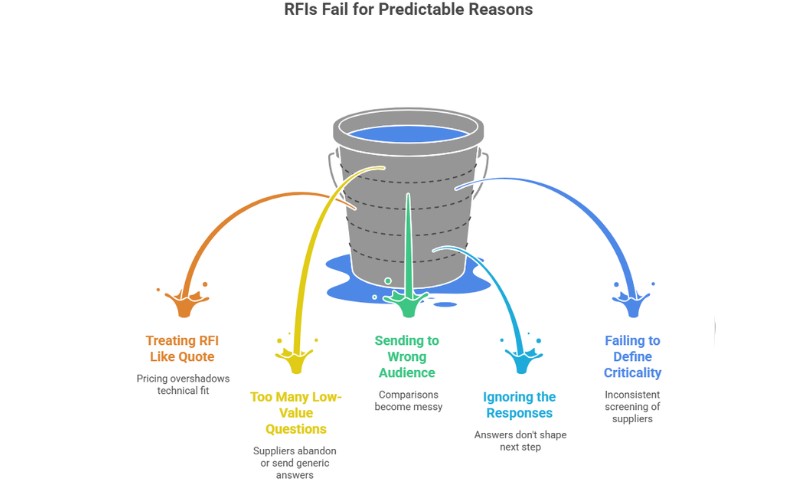
A lot of RFIs fail for predictable reasons.
Treating an RFI Like a Quote Request
Once pricing becomes the center of attention, suppliers often rush to numbers before technical fit is clear. That defeats the purpose.
Asking Too Many Low-Value Questions
Some RFIs turn into 80-question forms full of data nobody will use. Suppliers either abandon the process or send generic answers.
Sending RFIs to the Wrong Audience
If the sourcing list includes brokers, distributors, and direct manufacturers without clear labeling, comparisons get messy.
Ignoring the Responses
An RFI only works if answers shape the next step. Good teams score responses, document risks, and decide who moves forward.
Failing to Define Criticality
APIC’s guidance makes a strong point here: qualification depends on the material or service and its intended use, with higher-criticality items requiring deeper qualification.
That logic applies well beyond pharma. A supplier for disposable packaging should not be screened the same way as a supplier for a critical machined component inside a safety-sensitive assembly.
Final Thoughts
An RFI gives manufacturers a disciplined way to ask early questions before money, lead times, and contracts start driving the conversation. Used at the right moment, it improves supplier selection, sharpens planning, and lowers the odds of expensive surprises later.