

What Is RFQ? Meaning, Process, and Why It Matters in Manufacturing
In manufacturing, one weak quote can ripple through production schedules, margins, inventory levels, and customer deadlines. RFQ, short for Request for Quotation, sits right at that pressure point.
It is one of the main tools buyers use when they already know what they need and want suppliers to price the job against a defined set of requirements.
When used well, an RFQ creates cleaner comparisons, fewer surprises, and better purchasing decisions. When used poorly, it can produce cheap-looking bids that later turn into delays, change orders, or quality disputes.
What Really Matters
- RFQ is a formal request suppliers use to price the same clearly defined job.
- In manufacturing, a strong RFQ helps prevent delays, quality issues, and hidden costs.
- The best quote is not always the cheapest one, lead time, quality, and risk matter too.
- Weak RFQs often lead to disputes, re-quotes, and expensive sourcing mistakes.
RFQ Meaning
An RFQ is a formal request sent to suppliers asking them to submit a price quote for specific goods, services, or manufacturing work. In procurement practice, it works best when specifications are clear, quantities are known, and suppliers are pricing roughly the same scope.
SAP describes procurement as the business function responsible for sourcing, purchasing, receiving, and inspecting the goods and services a company needs, while the United Nations University notes that RFQs are suited to goods, services, or work with standard and clear specifications.
In a factory setting, that might mean asking 5 qualified suppliers to quote 20,000 stamped brackets made from a named grade of steel, with exact tolerances, packaging rules, inspection criteria, and a delivery window.
It could also mean a contract manufacturer requesting quotes for CNC machining, powder coating, molded plastic housings, or a recurring packaging component used in a production line. The common thread is clarity. Buyer and supplier are supposed to be pricing the same job.
RFQs are often confused with other sourcing documents, especially RFPs and bids. The line that matters most is simple: an RFQ is mainly about comparable pricing for a defined need.
An RFP comes into play when the buyer needs suppliers to propose a solution, not merely price a fixed one.
United Nations University draws that distinction directly, noting that an RFP is used when needs cannot be expressed in enough detail for a straightforward price competition, and the award is not necessarily based on the lowest cost.
Why RFQs Matter So Much in Manufacturing
Manufacturing companies live inside constraints: material cost, machine capacity, labor availability, quality requirements, engineering tolerances, and promised ship dates. Procurement sits in the middle of all of them.
SAP notes that for manufacturing companies, supply availability is especially critical because finished goods cannot be made without required inputs.
That is why an RFQ is more than paperwork. It helps a buyer lock down price, confirm lead time, test supplier fit, and spot risk before a purchase order is issued.
A well-built RFQ also improves comparison quality. If every supplier receives the same drawing pack, annual volume forecast, packaging requirement, quality standard, and commercial terms, the buyer has a far better shot at comparing like with like.
Mitsubishi Heavy Industries Engine & Turbocharger’s supplier guidance shows how formal quote requests often require annual quantity assumptions, all relevant costs, shipping terms, and disclosure of any exceptions to drawings or specifications. That structure reduces ambiguity and exposes gaps early.
Quality risk is another major reason RFQs matter. NIST’s supplier evaluation procedure points to the need for suitable specifications, acceptance criteria, inspection on receipt, and supplier evaluation against factors including cost, turnaround time, and product availability.
ASQ likewise describes supplier performance through long-standing indicators such as quality, cost, and delivery. In practical factory terms, a low quote means very little if incoming parts fail inspection or arrive late enough to idle a line.
Where RFQ Fits in the Manufacturing Buying Process

An RFQ usually appears after a buyer has already done enough homework to define the job. Engineering may have released drawings. Operations may have forecast usage. Quality may have listed inspection needs. Finance may have target cost assumptions.
Procurement then packages all of that into a quote request and sends it to suppliers that look capable of meeting the requirement. NIST’s small business guidance notes that companies commonly begin supplier outreach with an RFP, RFQ or RFI, when ready to solicit bids.
A common flow looks like the one below.
| Stage | What Happens | Why It Matters |
| Need identified | Plant, engineering, or sourcing team defines the requirement | Prevents buying vague or incomplete scope |
| Specifications prepared | Drawings, materials, tolerances, volumes, and terms are documented | Makes supplier quotes comparable |
| RFQ issued | Qualified suppliers receive the same request | Creates competition and visibility |
| Supplier questions handled | Clarifications, exceptions, and alternate ideas surface | Reduces hidden assumptions |
| Quotes evaluated | Price, lead time, quality risk, tooling, logistics, and terms are reviewed | Avoids choosing on price alone |
| Supplier selected | Award decision moves toward purchase order or contract | Converts quote into an executable plan |
| Performance tracked | Delivery, quality, and commercial results are monitored | Improves future sourcing rounds |
That sequence reflects how procurement and supplier evaluation are treated in practice across official and industry guidance, especially around the importance of clear requirements, competitive solicitation, and post-award supplier review.
What a Manufacturing RFQ Usually Includes
A serious manufacturing RFQ goes far beyond “Please send price.” Buyers need enough detail to avoid apples-to-oranges quotes.
Government and multilateral procurement templates also show how structured such requests can be, often including schedules of requirements, submission forms, technical and financial offer formats, delivery instructions, and compliance conditions.
A typical manufacturing RFQ may include:
- Part name, item number, revision level, and drawings
- Material grade or approved material options
- Dimensional tolerances and finish requirements
- Estimated annual or monthly volume
- Minimum order quantity or lot size assumptions
- Tooling responsibility and ownership terms
- Packaging and labeling rules
- Inspection standards and required certificates
- Target lead time and delivery schedule
- Incoterms or freight assumptions
- Payment terms
- Validity period for quoted pricing
- Deadline for supplier questions
- Deadline and format for quote submission
Mitsubishi’s supplier quote instructions offer a useful real-world example.
Suppliers are told to include packaging costs in unit pricing, state shipping basis, and note any major exceptions to drawings or specs at the quote stage.
Such details are exactly where many future disputes begin, so pulling them into the RFQ saves time later.
RFQ vs. RFP vs. Bid – The Difference Buyers Need to Know
Manufacturing teams often mix up sourcing terms, especially in companies without a mature procurement function. The distinctions are easier to see in a side-by-side view.
| Document | Best Used When | Supplier Response Focus | Award Logic |
| RFQ | Requirements are clear and standardized | Price, lead time, commercial terms, compliance | Often strongest value among comparable quotes |
| RFP | Buyer needs suppliers to propose the approach or solution | Method, capability, technical response, pricing | Multi-factor evaluation, not purely lowest price |
| ITB / Bid | Standardized requirement with formal competition | Bid against exact requirement | Often lowest responsive, qualified bid |
United Nations University states that RFQ suits standard and clear specifications, while RFP suits cases where requirements cannot be expressed in enough detail for a straightforward price comparison.
Its ITB guidance places formal bidding on clearly specified goods at higher values, where the qualified low-cost bidder wins.
In manufacturing terms, an RFQ makes sense for repeat parts, standard components, packaging materials, machined parts with final drawings, or recurring outsourced processes.
An RFP makes more sense for plant automation design, a custom warehouse system, a complex MES rollout, or a major line redesign where supplier expertise shapes the solution itself.
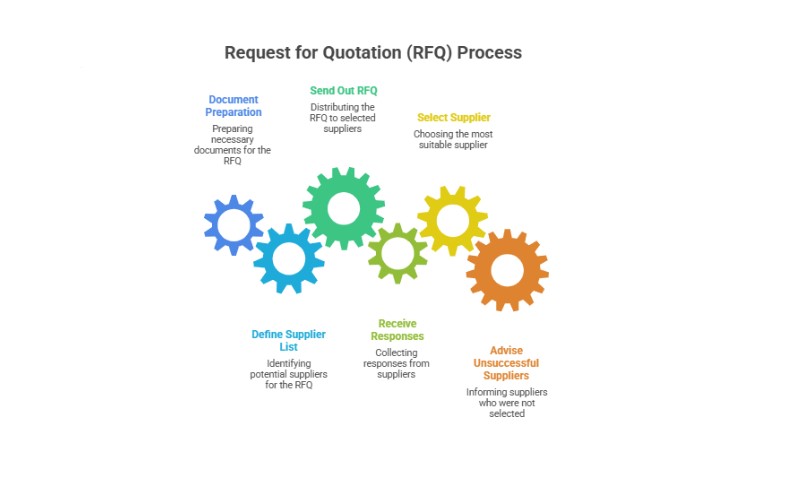
The RFQ Process, Step by Step
Here’s how it works:
1. Define the Requirement Properly
Everything starts with scope accuracy. If engineering drawings are unfinished or volume assumptions are unrealistic, the quote round will be weak from the start.
NIST’s supplier evaluation procedure places strong emphasis on suitable specifications, acceptance criteria, and communication of requirements to providers.
For a manufacturer, that means answering practical questions before the RFQ goes out:
- Is the drawing released and revision-controlled?
- Are tolerances manufacturable at the target cost?
- Are forecast volumes credible?
- Are inspection rules clear?
- Is there a preferred source for raw material?
- Is a first article approval required?
Missing answers at that stage usually reappear later as supplier assumptions, re-quotes, or nonconformance.
2. Choose the Right Suppliers
An RFQ only works if it reaches suppliers that can actually build the part or perform the process. Supplier scouting and supplier evaluation matter here.
NIST’s Manufacturing Extension Partnership describes supplier scouting as a way to identify domestic manufacturing capabilities, while NIST’s own evaluation procedure points to ongoing lists of acceptable suppliers and evaluation against defined criteria.
A buyer might short-list 3 to 6 suppliers based on process capability, certifications, geographic fit, capacity, tooling experience, or past delivery record. Sending an RFQ to 20 random vendors may create noise, not value.
3. Issue a Clear RFQ Package
Once suppliers are selected, procurement sends the same package to every participant. Written RFQs generally require a clear statement of quality, quantity, delivery timing, and special requirements, according to public procurement guidance.
World Bank RFQ documents also show how formal quote packages can include technical requirements, tests, eligibility language, and contract conditions.
Good buyers also control the question process. If one supplier asks a useful technical question, the answer often needs to go to every participant so the field stays level.
4. Collect Quotes and Clarify Exceptions
Suppliers rarely return a quote with zero caveats. One may propose a longer lead time. Another may suggest a substitute material.
Another may split price between tooling and piece-part cost. Another may hold price only for 30 days because metal markets are moving.
Mitsubishi’s supplier instructions expressly require vendors to identify major exceptions to drawings or specifications at quotation time.
A disciplined buyer logs every exception. Cheap pricing can look very different once freight, tooling amortization, scrap assumptions, or quality documentation charges are normalized.
5. Evaluate More Than Unit Price
Price matters, but manufacturing procurement rarely succeeds by staring at unit price alone. ASQ highlights quality, cost, and delivery as long-standing supplier performance indicators.
SAP’s supplier evaluation framework includes price, quality, delivery, service, invoice verification, and sustainability. NIST’s supplier evaluation procedure adds product availability and turnaround time.
A realistic evaluation grid may weigh:
- Piece-part price
- Tooling cost
- Freight or landed cost
- Lead time
- On-time delivery history
- Quality certifications
- Capacity and scalability
- Financial stability
- Responsiveness during quote phase
- Risk tied to geography or sub-tier sourcing
For example, Supplier A may offer a bracket at $1.82 with an 18-week lead time and offshore freight exposure, while Supplier B offers $1.95 with a 6-week lead time and local emergency support.
6. Award and Convert the Quote Into Execution
Once a supplier is selected, the quoted terms usually feed into a purchase order, framework agreement, or sourcing award. That handoff needs care.
Quote details must match the final commercial document, including revision level, lead time, packaging, quality documentation, and any approved deviations. A good RFQ process reduces later friction, but only if award documents reflect the final agreed terms.
Why Weak RFQs Create Expensive Problems
Many RFQs fail for reasons that look small at first. A drawing pack may be outdated. A finish requirement may be buried in a note.
A buyer may request annual pricing without naming the forecast volume. Packaging rules may be skipped until after award. Freight basis may be unclear. Quality documentation may never be priced in.
Problems that often grow out of weak RFQs include:
- Quotes that cannot be compared fairly
- Re-quotes after engineering clarifications
- Hidden charges that surface after selection
- Late deliveries caused by unrealistic timelines
- Quality escapes tied to vague acceptance criteria
- Supplier disputes over tooling, packaging, or logistics responsibility
NIST’s purchasing procedure is a useful reminder here. It stresses acceptance criteria, suitable specifications, inspection, and documented communication of requirements. In other words, procurement quality begins long before receiving inspection.
What Buyers Should Look For in Supplier Quotes
A strong quote usually shows more than a number. It shows whether the supplier read the package carefully and can execute the work with discipline.
Good responses tend to include explicit assumptions, lead times, tooling details, revision references, quality commitments, and commercial terms. Weak responses often hide behind a low unit price and vague wording.
A buyer should pay close attention to:
| Quote Element | Why It Deserves Scrutiny |
| Revision level | Wrong revision can make the quote unusable |
| Volume assumptions | Unit price may change sharply with annual quantity |
| Tooling charges | One-time versus amortized cost changes true economics |
| Lead time | A cheap part with slow supply can hurt production |
| Quality documentation | PPAP, FAI, certs, or test reports may add cost |
| Packaging | Poor packaging can raise damage rates and labor cost |
| Freight basis | EXW, FOB, delivered pricing, and landed cost differ |
| Price validity | Commodity-driven parts may have short validity windows |
| Exceptions | Hidden deviations can become future disputes |
Mitsubishi’s quote rules around packaging, shipping basis, and exceptions show how experienced buyers force critical items into the quote response rather than leaving them for later negotiation.
A Simple Manufacturing Example
Picture a company that makes commercial kitchen equipment and needs 12,000 stainless steel hinges per year for oven doors. Engineering has final drawings. The hinge requires a specified alloy, passivation, dimensional tolerances, and cycle-life performance. Procurement sends an RFQ to 4 metal component suppliers.
Supplier responses come back like this:
- Supplier 1 offers the lowest unit price, but only with a 24-week lead time and overseas freight.
- Supplier 2 prices 7% higher, but carries local stock of raw material and can ship in 5 weeks.
- Supplier 3 matches the lead time but excludes passivation from base price.
- Supplier 4 proposes a design tweak that could cut cost later, but current quote is incomplete.
If engineering wants a future cost-down project, Supplier 4 may still be worth developing for a later round.
RFQ work is often less about picking the cheapest line on a spreadsheet and more about making the production system safer and more predictable.
ASQ and NIST guidance both support that broader view by framing supplier performance around quality, delivery, cost, and availability, not price alone.
Why RFQs Still Matter Even With Digital Procurement Tools
Digital sourcing tools can automate distribution, deadline tracking, comparison sheets, and supplier communication. SAP’s sourcing materials frame RFQs as a central procurement step for soliciting and comparing supplier price proposals.
Yet software does not fix a bad scope. A messy drawing, an unrealistic forecast, or missing acceptance criteria will still produce a messy result in a polished portal.
The real value of digital RFQ systems lies in consistency. They can help procurement teams standardize templates, track supplier response history, preserve quote records, and compare commercial terms faster.
That matters in manufacturing groups managing hundreds or thousands of parts across multiple plants.
Practical Tips for Writing a Better RFQ
A buyer trying to improve quote quality can make a noticeable difference with a few habits:
- Send only released drawings and controlled documents.
- State annual usage and order pattern assumptions clearly.
- Name required certifications, tests, and inspection standards.
- Spell out packaging, labeling, and freight expectations.
- Ask suppliers to list every exception in one section.
- Normalize quotes before comparison.
- Keep a written log of clarifications sent to all bidders.
- Score risk factors alongside price.
UN procurement guidance also advises suppliers to study tender documents carefully and ensure offers meet all required forms and supporting materials.
On the buyer side, that same logic applies in reverse: the cleaner the package, the better the responses.
Final Takeaway
RFQ stands for Request for Quotation, but in manufacturing it carries a larger job than the acronym suggests. It helps buyers turn a defined need into a structured supplier competition, compare offers on a common basis, and make sourcing choices that support production instead of disrupting it.
Good RFQs create clarity. Poor ones invite cost drift, late deliveries, and quality trouble. For factories where margins are tight and schedules are unforgiving, that difference matters a lot.